Zoroastrianism
Page 1 | Page 2 |
Page 3 | Page 4 |
Page 5 | Page 6
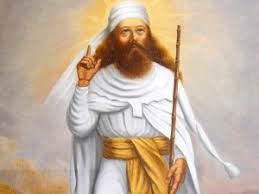
Zarathushtra Spitama

Who are Zoroastrians?
Asho Zarathushtra
|
Zoroastrians (or Zarathushtrians) are the followers of a visionary messenger named Zarathushtra who lived
in Iran over 1000 years before Christ. His 200,000 or so followers are scattered throughout the world, the
largest numbers remaining in Iran and India.
The Greater Toronto Area has the largest population of
Zarathushtrians in North America, approximately 5000 in number.
|

When was Asho Zarathushtra born?
No one knows for sure. Dates fixed by different scholars range between 6000 BC to 630 BC. But does it
really matter to us when he was born? Isn't it enough to know that he lived and revealed one of the most
enlightened guidelines for human behaviour?

Why do we call him Asho Zarathushtra Spitama?
Asho is a title of respect derived from the Avestan word
Asha meaning
righteousness. Zarathushtra, meaning
"one possessing a golden-coloured camel," was his given name. Spitama was the family name.

What was his life like?
Very little is known about him. You have to remember that the era was prehistoric, writing, as we know
it today, hadn't been invented. What is definitely known and universally accepted is that he was born
to Dughdova and Pourushaspa in Aryana Vaeja (land of the Aryans i.e. Central Asia). At the age of
twenty years, he went to Mount Ushidaren to meditate. After ten years of self-study, he received the
revelation that there is only one universal source of wisdom Ahura Mazda, and that the aim of human life
is to strive to be reunited with Him. It took Asho Zarathushtra many years of struggle before the
superstitious and gods-fearing people accepted his word. And this acceptance happened largely through
the support and patronage of Kai Vishtasp, the ruler at that time, and his consort Hutaosa. Nothing
has been stated, directly or indirectly, about Asho Zarathushtra passing away, leading one to believe
that it must have been through natural causes.
Thousands of years later, dramatic embellishments were added to the story of Asho Zarathushtra's life. This
includes the saga of Durasobrab's attempts on the life of baby Zarathushtra and his miraculous escapes;
Zarathsuhtra's confrontation with the jealous sorcerers at Kai Vishtasp's courts; and his murder in the
temple by Turi Bradosh.

Will Zarathushtra be resurrected as a Saviour at the end of time?
In Persian mythology, three saoshyant (those who bring benefit) will appear, one every millennium after
Zarathushtra's death. Each will be born of a virgin miraculously impregnated with Zarathushtra's "seed"
while bathing in Lake Kansaoya (geographical location unknown).
The three Saoshyants will be:
1) Ukhshyat-ereta -
he who makes righteousness grow.
2) Ukhshyat-nemah -
he who makes reverence grow.
3) Astvat-ereta -
he who embodies righteousness.
It is important to qualify, that the myth of coming of the three saoshyants emerged in the Achaemenian time,
more than a thousand years after the time of Zarathushtra. It was later documented in great descriptive
detail in the Bundahisn (circa 6 AD), and was definitely influenced by the other beliefs of that time.
(Saviour born of a virgin....sound familiar?)
The term saoshyant relayed by Zarathushtra in the Gathas is unrelated to these mythical men. He spoke of a
man who will lead the world on a "Path that leads up to the World of Truth" (Yasna 43.3). However, whether
this is interpreted as one particular man, or as each righteous human being who seeks out the path of Asha
is up to individual belief. I believe that it is up to all human beings to work individually, but as a
collective force, to "save" the universe, both at a physical and at a spiritual level. The word saoshyant,
is sometimes said to be saviours in a superhero sense, but if you go back to the original meaning "one who
brings benefit" then any benefactor of humanity in any field of human endeavour can possibly be a saoshyant.
Page 1 | Page 2 |
Page 3 | Page 4 |
Page 5 | Page 6
Information provided by Farishta Murzban Dinshaw